

Type: developer interview conducted at TGS 2025.
In an interview published on September 26, 2025, producer Riichiro Yamada spoke about the "reality" the new Virtua Fighter is aiming for.
Yamada said "the concept is reality," explaining that "the reason we say 'reality' rather than 'real' is that we don't want to make something that is real martial arts itself."
He added that the series has always been influenced by kung-fu movies, and what the team wants to make is movie-like action.
Some of these systems were first revealed the previous day, September 25, on a stage that also featured battle director Yosuke Takeda and pro gamer Tokido (related article).
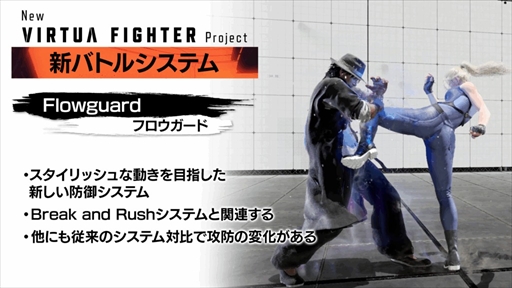
Flow Guard: a "parry" distinct from blocking
Flow Guard was introduced as a defensive mechanic separate from ordinary blocking, notable for not taking part damage while active.
Yamada said, "Guarding in fighting games tends to be highly symbolic, so holding a guard ends up looking similar across the board. That's not the reality we're aiming for."
Break & Rush: breaking parts to push offense
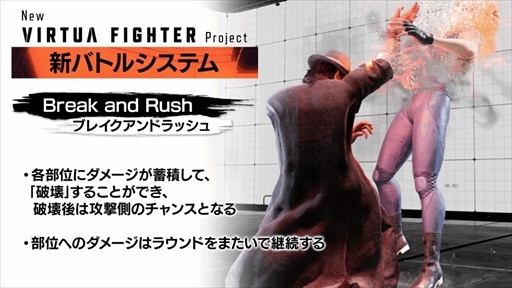
Break & Rush was described as a system that accumulates and eventually breaks part-specific damage from landed attacks, with that damage carrying over between rounds.
Yamada said, "Because Flow Guard exists as a defensive option, leaving things as they are would favor the defender and slow the pace of the match. We want a game where attacking, not defending, opens the path forward."
He also said the part-breaking feature is "intuitive and easy to understand even for people who aren't gamers."
Stunner and stun combos: answering "I don't know what to do"
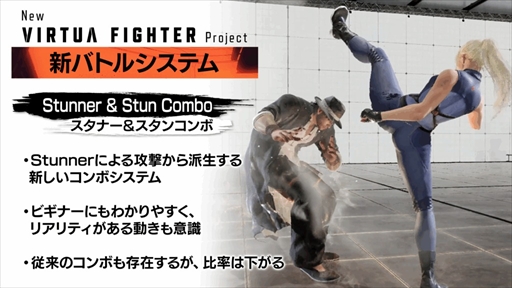
Stunner and stun combos were introduced as a new combo type that connects with realistic motion rather than launching the opponent into the air, while existing air combos remain.
Yamada explained, "We heard from beginners playing Virtua Fighter that they didn't know what to do, and Stunner and stun combos are partly a response to that."
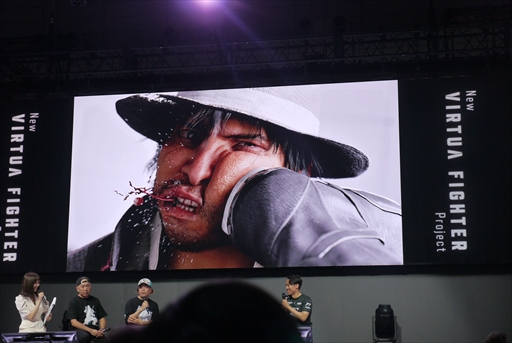
Signature Cut: a KO cut-in within CERO-D limits
Signature Cut is a cut-in that expresses the pain of a blow at the moment of KO, and its content changes depending on how the KO happens.
Yamada said, "Put simply, it's an expression kept within CERO-D limits. We don't want to make something grotesque; we want to show something with reality and a sense of impact."
He also said an option to turn the bleeding depiction on or off is planned for players who prefer not to see it.
Uprising: a new rule that changes how the game is played
Uprising was introduced not as an addition to the existing systems but as a new rule meant to change the way the game is played.
Yamada said, "It's a new rule we made because we wanted to change how the game is played. Just as battle royale grew out of shooting-game rules, a game can grow bigger by changing its rules."
Thinking on controls and the entry barrier
Input methods are still being tested, but new elements are planned to use simple inputs, and the team said it will keep the simplicity of controlling the game with P, K and G.
Yamada also said, "This time, we simply want to lower the barrier to playing."
Air combos and match speed
With the new systems, long air combos are expected to become harder to connect, though the team said this does not mean rejecting air combos outright.
They also said the speed at which matches are decided will stay at the same level as previous entries.
Showing part damage and its effect on existing characters
The team said it wants part damage to be visible, including reflecting its state in a character's appearance at the start of a round.
Adding the new systems may change the balance between characters, but the team said it will preserve the image each character carries.
What this interview did not confirm
How part damage accumulates for each character and the final input methods were only described as still being balanced, not as finalized details.
Release date, supported platforms, and the character roster were not covered in this interview.
Original source